Mount Kilimanjaro National Park and Safari Guide
Africa's highest mountain, climbed on foot and paired with Tanzania's wildlife parks for a trip that covers both summit and safari.
Mount Kilimanjaro National Park is in northern Tanzania, just south of the Kenyan border. It protects Africa’s highest mountain, from its montane forest up to the glaciated summit. Most visitors come to climb the mountain over several days. Others walk part of the lower slopes in a day, then go on to wildlife parks such as Tarangire, Ngorongoro and the Serengeti. Climbing Kilimanjaro and going on a game-drive safari are separate activities, but many people combine them in one Tanzania trip.
Where is Mount Kilimanjaro National Park?
In the Kilimanjaro Region of northern Tanzania, near the town of Moshi and about 300 km south of the equator. Kilimanjaro International Airport (JRO) lies between Moshi and Arusha.
Is Kilimanjaro a safari destination?
Not in the conventional sense. The park is a mountain and forest reserve, not a game-drive park. People go there to climb, hike and see the landscape. “Kilimanjaro safari” usually means a trip that pairs the mountain with wildlife parks elsewhere in northern Tanzania.
What animals live in the park?
Forest primates such as blue monkeys and black-and-white colobus, small antelopes such as duikers and bushbuck, many forest and alpine birds, and larger mammals such as elephant and buffalo that are rarely seen. You will not find the dense herds and predator viewing of the Serengeti here.
How many days do visitors need?
One day for a guided forest hike on the lower slopes. Five to nine days on the mountain for a summit climb, plus arrival and recovery days.
Can Kilimanjaro be combined with a wildlife safari?
Yes. The most common plan is a climb followed by three to seven days of safari in Tarangire, Lake Manyara, Ngorongoro and the Serengeti. Arusha is the starting point for the safari part.
Mount Kilimanjaro National Park is in the Kilimanjaro Region of northeastern Tanzania. The mountain rises from farmland and savannah close to the Kenyan border. UNESCO places the park roughly 300 km south of the equator, near Moshi.
Location Summary
How the Main Places Relate
Kilimanjaro International Airport sits between Moshi and Arusha. It is about 40 km from Moshi, a drive of roughly 45 to 60 minutes. Arusha is about 50 to 60 km from the airport, normally a drive of 60 to 90 minutes depending on traffic. The Moshi–Arusha road is about 79 km. In practice, climbers usually stay in Moshi or in villages on the lower slopes such as Marangu or Machame. Safari travellers usually start from Arusha.
Map Guidance
On a map of northern Tanzania, Kilimanjaro is the eastern end of the northern safari circuit. Moving west from the mountain you reach Moshi, then Arusha (with Mount Meru and Arusha National Park), then Tarangire and Lake Manyara, then the Ngorongoro highlands, and finally the Serengeti plains. Kenya’s Amboseli National Park lies across the border on the mountain’s northern side.
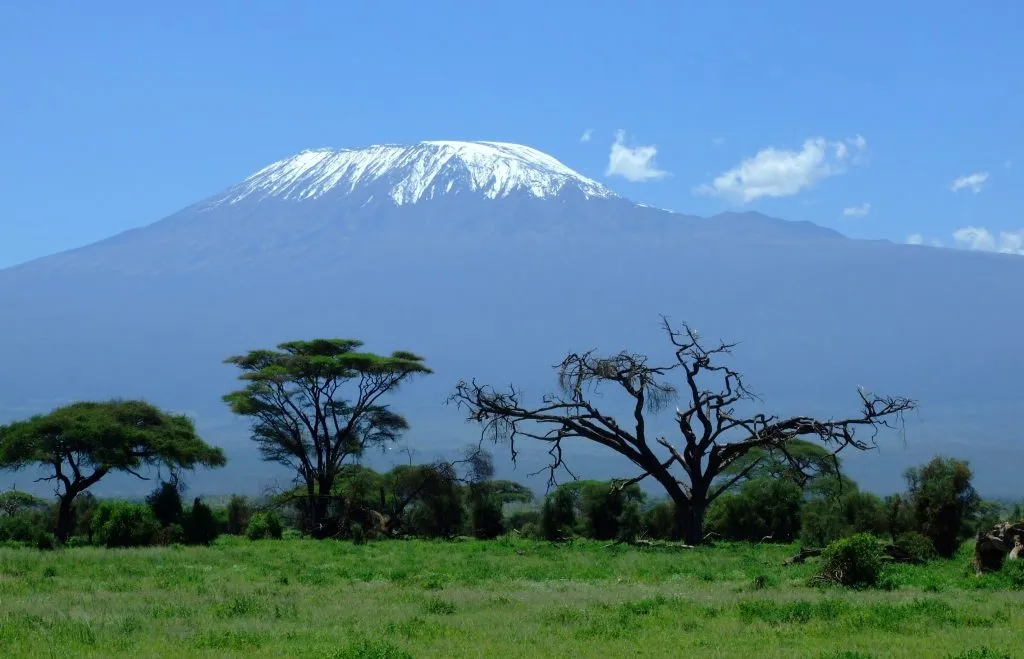
The park is known mainly for Mount Kilimanjaro, the highest point in Africa at 5,895 m. UNESCO describes it as the largest free-standing volcanic mass in the world. It rises about 4,877 m above the plains around it. UNESCO inscribed the park as a World Heritage Site in 1987.
Volcanic Origins and Peaks
Kilimanjaro is a large stratovolcano with three main volcanic centres:
- Kibo, the highest and youngest, with the summit at Uhuru Peak
- Mawenzi, a jagged, eroded peak to the east
- Shira, an older collapsed volcano that now forms a broad plateau to the west
Between Kibo and Mawenzi lies the Saddle, a high, dry plateau. Conservation literature describes it as the largest area of high-altitude tundra in tropical Africa.
Ecological Zones
Walking up Kilimanjaro takes you through a series of climate and vegetation bands, each with a different feel:
- Cultivated lower slopes: farms, coffee and banana gardens, and villages, mostly outside the park
- Montane forest: the wettest zone, with tall trees, moss, ferns and most of the mountain’s wildlife
- Heath and moorland: open ground with giant heathers, giant groundsels and lobelias
- Alpine desert: dry, rocky and exposed, with hot days and freezing nights
- Arctic summit zone: ice, scree and the remaining glaciers around Kibo’s crater
Park Size: A Note on the Figures
You will see two figures quoted. UNESCO records the World Heritage property as about 75,575 hectares, roughly 756 km². The park was created in 1973 to cover the mountain above the tree line plus forest corridors. It was later extended (UNESCO notes an extension in 2005) to take in more of the montane forest. Many park and operator sources now give the total area as about 1,688 km². Both figures appear in good faith because they describe different boundaries.
How It Differs from Tanzania’s Game-drive Parks
The Serengeti, Tarangire and Ngorongoro are mostly explored by vehicle in search of large mammals. Kilimanjaro is explored on foot, with registered guides, along fixed routes. The appeal is the mountain itself, the change of habitats with altitude and, for climbers, the summit. Visitors who expect a Big Five game drive on Kilimanjaro will be disappointed. Those who come for the mountain and then go elsewhere for wildlife get the best of both.
Kilimanjaro has a real wildlife community, but most of it lives in thick forest and is hard to see. Treat sightings as a bonus, not a reason to visit.
Animals You Have a Reasonable Chance of Seeing
- Blue monkeys, often seen in the forest on the lower trails, including the Marangu route
- Black-and-white colobus, shyer than blue monkeys but regularly seen in forest trees
- Forest and alpine birds, from turacos and sunbirds in the forest to white-necked ravens and other birds at higher camps
- Smaller animals such as four-striped grass mice, chameleons and other reptiles in suitable habitats
Animals Present but Rarely Seen
- Elephant and buffalo, which use the lower forest, much of it away from the main trails
- Leopard, which is present but very seldom seen by walkers
- Duikers and bushbuck in the forest, eland and other antelopes on the open western slopes
- Abbott’s duiker, an endangered forest antelope found in only a few places in Tanzania, Kilimanjaro being one of them. Even specialists may search for days without seeing one.
- Nocturnal species such as bushbabies, genets and honey badgers, which most hikers never see because walking at night is not allowed in the forest
Birdlife
Kilimanjaro sits within a recognised Important Bird Area, and the forest belt is the richest part of the mountain for birds. Birdwatchers do best on a slow guided forest walk in the morning rather than during a climb, when the focus is on reaching camp.
What to Expect, Realistically
On a typical day hike you may see monkeys and a few forest birds. On a climb you will mostly see plants, landscape and birds, with mammals now and then lower down. If big animals are the main reason for your trip, plan days in Tarangire, Ngorongoro or the Serengeti.
Kilimanjaro is a mountain destination, not a wildlife-safari park. The word “safari” just means “journey” in Swahili, so a “Kilimanjaro safari” can mean several different trips. It helps to be clear which one you want.
What “Kilimanjaro Safari” Can Mean
- A visit to the national park: a guided day hike or short walk on the lower slopes, focused on forest, scenery and the experience of being on the mountain.
- A climb followed by a wildlife safari: the most popular combination. A five-to-nine-day climb, a rest day, then game drives in the northern parks.
- A northern Tanzania holiday with Kilimanjaro as a backdrop: a wildlife safari that begins or ends near the mountain, perhaps with a day hike or a cultural visit on its slopes but no climb.
Deciding What You Want
- Do you want a physical challenge and are you willing to spend a week at altitude? Choose a climb.
- Do you want to see lions, elephants and big herds? Choose a game-drive safari in the northern parks.
- Do you want both but have limited time? A climb plus a three-to-four-day safari is the shortest version that does justice to each.
- Do you want a taste of the mountain without the effort of a climb? Choose a day hike, then go on safari.
The main activity is trekking, from short day hikes to full summit climbs. Every hike inside the park needs a licensed guide, and every visit means paying park fees at a gate.
Summit Climbs
A multi-day climb to Uhuru Peak on one of the official routes. Most visitors to the park come for this. The details are in the route planning section below.
Day Hike from Marangu Gate to Mandara Hut and Maundi Crater
This is the standard way to visit the park without climbing. The trail starts at Marangu Gate (about 1,860 m). It climbs through montane forest to Mandara Hut (about 2,700 m), roughly 8 km one way. That is the first day of the Marangu climbing route. From the hut, a short walk of about 15 minutes leads to Maundi Crater. On a clear day the crater gives views over the surrounding plains and, if conditions allow, towards Kenya. Expect a full day of 6 to 9 hours of walking with a gain of around 900 m. It is a steady, sometimes steep hike, not an easy stroll. Operators note that Marangu is the route used for short treks of this kind.
Forest Walks and Birding
Slow, guided walks in the lower forest give the best chance of seeing monkeys and forest birds. Arrange them with a licensed operator and confirm which gate and trail you will use.
Scenery and Photography
The Shira Plateau on the western side is a broad high-altitude landscape with views of Kibo. It is usually reached as part of a climb on the Lemosho or Shira routes. Some operators arrange vehicle access to parts of the western slopes. Confirm current access with your operator and TANAPA before planning around it.
Activities Near the Park, Not Inside It
Several popular excursions from Moshi take place on the mountain’s lower slopes but outside the national park. These include coffee farm and Chagga cultural tours around Marangu and Materuni, the Materuni waterfall walk and Lake Chala on the eastern edge near the Kenyan border. They are good for families and for people with spare half days, but they are not national park visits. They usually cost less because they do not involve park fees.
A summit climb takes five to nine days on the mountain. The time depends on the route and how many acclimatisation days it includes. Add at least one night before the climb and one after, so most climbers allow about 7 to 11 days in total.
TANAPA maintains seven main climbing routes. Here is an overview of typical itineraries offered by licensed operators. Durations vary by company.
| Route | Typical length | Notes |
|---|---|---|
| Marangu | 5 to 6 days | The only route with sleeping huts instead of tents. The same path goes up and down. Popular with people who prefer huts. The 6-day version, with an extra night at Horombo, gives better acclimatisation than 5 days. |
| Machame | 6 to 7 days | Camping. Scenic and very popular. Steeper sections and busier campsites. |
| Lemosho | 7 to 8 days | Camping. Starts in the west and crosses the Shira Plateau. A gradual ascent profile and fewer people on the early days. |
| Shira | 7 to 8 days | Camping. Similar to Lemosho but starts higher, so the first days give less acclimatisation. |
| Rongai | 6 to 7 days | Camping. Approaches from the north near the Kenyan border. Often drier and quieter, with a gentler gradient. |
| Northern Circuit | 8 to 9 days | Camping. The longest route, circling the northern side of the mountain. Gives the most time to acclimatise. |
| Umbwe | 6 to 7 days | Camping. Short and steep. Best for experienced trekkers who know how they cope with altitude. |
How to Choose a Route
- Time on the mountain is the biggest factor you control. Longer itineraries give your body more time to adjust and are generally linked with better summit chances. No operator can guarantee success.
- Huts or tents: Marangu is the only hut route. All others use camping.
- Scenery and crowds: Lemosho and the Northern Circuit cross more varied terrain and tend to be quieter in the early days.
- Budget: each extra day on the mountain adds park fees, crew wages and food.
Separate This from a Park Visit
A summit climb and a park visit are different commitments. A day hike to Mandara Hut takes one day and does not go above about 2,700 m. A summit climb means a week at altitude, a night ascent to 5,895 m in freezing temperatures, and real physical strain. Do not budget a single day “to see Kilimanjaro” and expect to reach the top.
The driest and most popular months to climb are January to early March and June to October. These months give the most stable trail conditions and the best chance of clear views. They are also when trails and campsites are busiest. No single month suits everyone.
Climbing
- January to early March: generally dry and clear, with a chance of snow near the summit. A good window that combines well with calving season in the southern Serengeti.
- Late March to May (long rains): wet, muddy forest trails and more cloud. Fewer climbers. Some operators run fewer departures.
- June to October: the main dry season. Cold nights at altitude, reliable weather and the busiest trails.
- November to early December (short rains): showers, often in the afternoon. Climbing is possible, but bring good rain gear.
Mountain Views
The summit is often hidden by cloud during the day. Early morning and late afternoon usually give the clearest views from Moshi, the lower slopes and the surrounding plains, especially in the dry months. Even in good seasons, a clear view is never guaranteed.
Forest Walks
The forest is green all year. In the rainy months it is wetter, muddier and slower going, but it is quieter and the vegetation is at its fullest.
Combining a Climb with a Safari
- Dry-season safari in Tarangire, Ngorongoro and the Serengeti: June to October lines up well with the main climbing season.
- Serengeti calving season in the south (around Ndutu): usually January to February, which matches the January–March climbing window.
- Northern Serengeti river crossings: usually around July to October, depending on herd movements. Plan for possibility, not certainty.
Most visitors fly into Kilimanjaro International Airport (JRO). From there they transfer to Moshi or Arusha, then drive to a park gate on the day their hike or climb begins.
Step by Step
- Fly into JRO. It is the main international gateway for northern Tanzania and handles both regional and long-haul connections. Some travellers arrive via Dar es Salaam or Nairobi and connect onwards.
- Transfer to your base. Moshi is about 40 km from JRO, roughly 45 to 60 minutes by road. Arusha is about 50 to 60 km away, usually 60 to 90 minutes.
- Drive to the gate on your start day. The gates are spread around the mountain, so transfer times depend on your route. Marangu Gate, used for the Marangu route and day hikes, is typically about an hour from Moshi. Western gates for Lemosho and Shira take longer to reach. Rongai starts on the northern side, near the border. Your operator arranges this transfer and registers you at the gate.
From Kenya
Travellers coming from Nairobi can fly to JRO, or travel by road through the Namanga border to Arusha. Moshi is about 320 km from Nairobi by road, around four and a half hours of driving without border delays. Check visa requirements for both countries.
Reaching a Gate Is Not the Same as Reaching a Safari Park
Once you finish on the mountain, your wildlife safari begins with a separate journey west from Arusha. Tarangire and Lake Manyara are a few hours’ drive away. Ngorongoro is roughly half a day. The Serengeti is a full day by road, or a short domestic flight from Arusha or JRO. Plan the day after a climb as a rest or travel day, not a game-drive day.
A trip that combines Kilimanjaro with a safari costs a mix of fixed government fees and variable operator costs. There is no single universal price. TANAPA sets the park fees, so they are the same whichever operator you use. Everything else varies.
Official Kilimanjaro park fees (non-resident adults)
Fees published for the 2026 TANAPA schedule:
Operators report that 18% VAT is added on top. Gates no longer accept cash; fees are paid electronically through a government payment system. For a seven-day camping climb, park fees alone usually come to around USD 1,000 per climber once VAT is included. Day hikers pay the daily conservation fee rather than climbing fees. Resident, East African citizen and child rates are different. Check the current TANAPA tariff before you budget, because fees can change.
Guide, Crew and Logistics
Licensed guides, assistant guides, porters, cooks, tents, food, safety equipment and gate transfers make up the rest of a climb price. This is where quotes differ most, depending on group size, route length, crew ratios, equipment quality and how the operator treats its crew. Very cheap climbs often save money on crew wages or safety. Ask what is included and whether the operator follows recognised porter-welfare standards. Tips for the mountain crew are customary and are usually paid separately.
Accommodation and Transfers
Plan hotel nights before and after the climb, airport transfers and the drive to and from the gate.
Equipment and Preparation
Good boots, layered clothing, a warm sleeping bag and rain gear. Many items can be rented in Moshi. Add travel insurance that covers trekking to the altitude you will reach, plus any vaccinations or medication your doctor recommends.
Wildlife Safari Costs
Adding a safari brings separate park and conservation fees for each area. The Ngorongoro Conservation Area is run by its own authority, not TANAPA, and has its own fee structure. You will also pay for vehicle and driver-guide days, lodge or camp nights, and any domestic flights. The cost depends on the season, the standard of accommodation, the number of days and whether you share a vehicle.
How to Compare Quotes
Ask each operator to list park fees separately from their own services, state the number of days inside the park, and confirm what is not included (tips, rental gear, drinks, visas, insurance). That makes quotes much easier to compare fairly.
Where you stay depends on your plan. Climbers mostly stay in Moshi or on the lower slopes. Day hikers can stay in either Moshi or Arusha. Safari travellers usually stay around Arusha before heading west. Apart from the mountain huts and campsites used during a climb, there is no general visitor lodging inside the park.
- Moshi: the most practical base for climbers. Close to JRO and to the southern and eastern gates, with plenty of hotels and guesthouses and gear-rental shops. Good for the night before and after a climb.
- Marangu and Machame villages: on the lower slopes outside the park, close to their gates. Quieter, cooler and closer to the mountain. Easy to combine with coffee farm and cultural visits.
- Arusha: the starting point for the northern safari circuit, with a wide range of hotels and lodges. A sensible base if your trip is mainly a safari with a single Kilimanjaro day hike.
- On the mountain: huts on the Marangu route, campsites on all other routes. You can only stay here as part of a registered climb.
After the climb, accommodation changes character. In Tarangire, the Ngorongoro highlands and the Serengeti you stay in lodges and tented camps inside or near the wildlife areas. That is a very different experience from a town hotel in Moshi. Many travellers book one comfortable night in Moshi or Arusha between the two for rest, a hot shower and laundry.
The usual sequence is: climb Kilimanjaro, rest for one night in Moshi or Arusha, then drive or fly west for game drives. Doing the safari first is also possible, but most people prefer to climb while they are fresh and finish the trip with something less demanding.
What Each Destination Adds
Big open plains, large predator populations and the seasonal wildebeest and zebra migration. It takes time to reach by road, so allow at least two nights, or fly in.
Ngorongoro Conservation Area and Crater
A dense concentration of wildlife inside a volcanic crater. One of the best places in the region to see black rhino, though sightings are never certain. Crater visits are usually half-day or full-day game drives from lodges on the rim or nearby.
Large elephant herds, baobab trees and very good dry-season game viewing. About two to three hours from Arusha, which makes it a good first stop after a climb.
A compact park between the Rift Valley escarpment and the lake, with groundwater forest, birdlife and varied wildlife. It fits well into a short itinerary on the way to Ngorongoro.
Comparison Table
| Destination | Role in the trip | Main appeal | Best suited to |
|---|---|---|---|
| Kilimanjaro National Park | Mountain experience | Climbing, forest hikes, altitude landscapes | Climbers, hikers, active travellers |
| Serengeti National Park | Main wildlife safari | Plains, predators, migration | Travellers with 2+ nights and a wildlife focus |
| Ngorongoro Crater | Concentrated game viewing | Crater ecosystem, chance of rhino | Travellers short on time, first-time safari-goers |
| Tarangire National Park | Easy-access safari | Elephants, baobabs, dry-season wildlife | Post-climb first stop, shorter trips |
| Lake Manyara National Park | Short scenic safari | Forest, lake, birdlife | Short itineraries on the way to Ngorongoro |
Realistic Itinerary Shapes
- About 10 days: 6-day climb plus rest night, then Tarangire and Ngorongoro (2 to 3 days of safari).
- About 13 to 14 days: 7- or 8-day climb, rest night, then Tarangire, Ngorongoro and the Serengeti (4 to 5 days of safari).
- Non-climbers, about 6 to 8 days: a Kilimanjaro day hike from Moshi, then Tarangire, Lake Manyara or Ngorongoro, and the Serengeti.
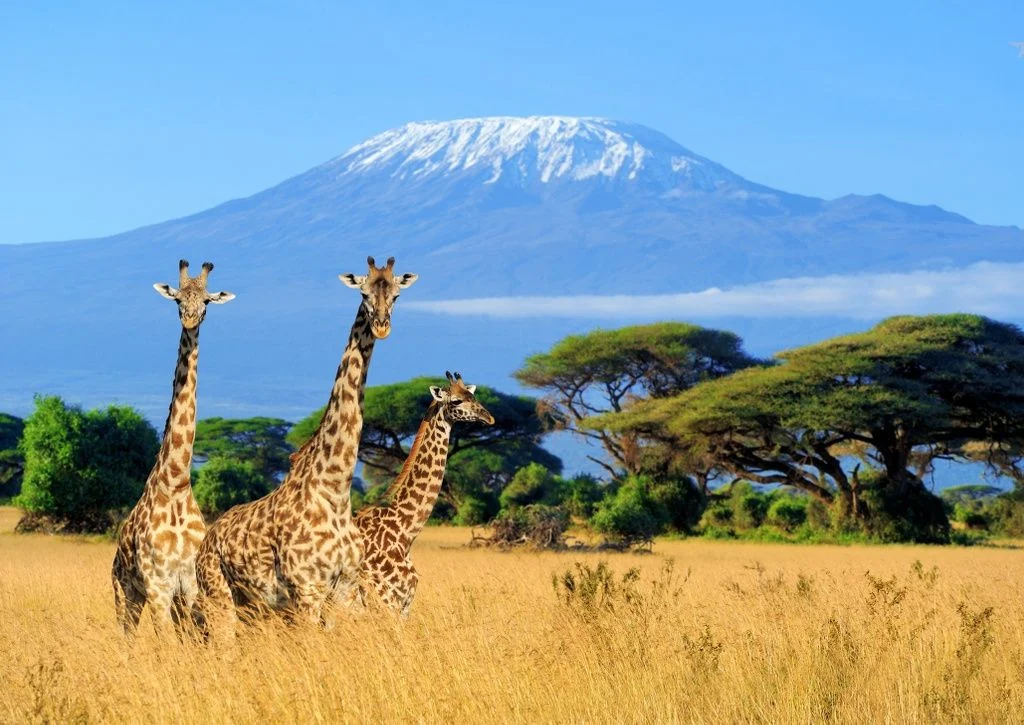
Mount Kilimanjaro is in Tanzania. Amboseli National Park is just across the border in Kenya, on the mountain’s northern side. Amboseli’s flat plains give an unobstructed view of Kibo rising behind elephants and acacias. That is why so many of the best-known photographs of Kilimanjaro are taken from Kenya, even though you cannot climb the mountain or enter its national park from Amboseli. UNESCO notes that the Kilimanjaro park is ecologically connected to Amboseli, and large mammals move across the wider landscape.
Visibility Is Not Guaranteed
Cloud often covers the summit for much of the day. Early morning and late afternoon tend to give the best chance of a clear view, and the dry months are usually more reliable. Some visitors spend several days in Amboseli and see the peak only briefly.
Kenya or Tanzania?
- Choose a Kenya safari that includes Amboseli if your goal is wildlife photography with Kilimanjaro in the background, and especially if you are also visiting the Maasai Mara.
- Choose a Tanzania itinerary built around Kilimanjaro if you want to climb or hike on the mountain and then go on safari in the Serengeti, Ngorongoro and Tarangire.
- Combining both countries is possible but needs time for border crossings and transfers.
What you pack depends on what you are doing. A summit climb needs specialist cold-weather gear. A day hike needs good walking kit and rain protection. A game drive needs light, neutral clothing and a warm layer for early mornings.
Summit Climbers
- Well-fitted, broken-in hiking boots and good socks
- Layers: base layers, fleece, insulated jacket and a waterproof shell
- Warm hat, gloves or mittens, and a buff
- Sleeping bag rated well below freezing (rental is possible)
- Headtorch with spare batteries
- Sun protection: high-SPF sunscreen, sunglasses and a lip balm with SPF. The sun is intense at altitude.
- Water bottles or a hydration bladder, plus a way to treat water if your operator does not supply it
- Trekking poles, which help especially on the descent
Day Hikers
- Comfortable walking shoes or boots with grip, as the forest trail can be muddy
- A rain jacket, plus a warm layer for the higher section near Mandara and Maundi Crater
- Water, snacks, sunscreen and a small daypack
Safari Travellers
- Light, neutral-coloured clothing; avoid bright colours on game drives
- A fleece or jacket for cool mornings, especially in the Ngorongoro highlands
- Binoculars, a hat, sunscreen and insect repellent
- A soft bag rather than a hard suitcase if you are taking light-aircraft flights
Altitude and Health
Altitude affects people unpredictably, and fitness does not protect you from it. Ascend gradually, drink enough water, tell your guide about symptoms early, and descend if advised to. Before booking a climb, talk to a doctor or travel-health clinic about altitude illness, medication and any existing conditions. Make sure your insurance covers trekking to 5,895 m and emergency evacuation.
Families and Travellers with Limited Time
TANAPA sets a minimum age for summit climbs, and operators apply their own policies. Check current rules before planning a climb with teenagers. For younger children and travellers short on time, a lower-slope day hike or a cultural visit around Moshi, combined with a safari, is usually a better fit.
Kilimanjaro’s forests are among the mountain’s most important features. They hold rainfall and mist, feed the streams and rivers used by surrounding communities and farms, and shelter species such as the Abbott’s duiker that survive in only a few places.
UNESCO reports that some of the wildlife corridors once linking Kilimanjaro to Arusha National Park and Tsavo have been encroached, which affects how animals can move across the landscape. The link with Amboseli remains. Pressure on the forest from fire, illegal logging and land demand at the park edge has long been a concern. The 2005 extension of the national park into the montane forest was partly a response to this.
The glaciers on Kibo have shrunk significantly over the past century, and scientists continue to study the combined role of climate and local factors. For visitors, the practical message is that the summit ice fields are smaller than in older photographs and are best treated as a changing feature, not a permanent one.
Visitors can reduce their impact by choosing operators that pack out all waste, treat porters fairly, stay on marked trails and respect park rules. Park fees also fund ranger services, trail maintenance and rescue operations.
Where is Kilimanjaro National Park located?
In the Kilimanjaro Region of northern Tanzania, near Moshi and close to the Kenyan border. The nearest major airport is Kilimanjaro International Airport.
Is Mount Kilimanjaro in Kenya or Tanzania?
Tanzania. The mountain is close to the Kenyan border and is often photographed from Kenya’s Amboseli National Park, but the mountain and its national park are entirely in Tanzania.
Is Kilimanjaro National Park good for a wildlife safari?
Not for a conventional game-drive safari. It is a mountain and forest park explored on foot. For lions, elephants and large herds, add the Serengeti, Ngorongoro or Tarangire.
What animals can you see on Mount Kilimanjaro?
Blue monkeys, black-and-white colobus and forest birds are the most likely sightings. Elephant, buffalo, leopard and rare antelopes live in the park but are seldom seen.
How many days do you need to visit the park?
One day for a guided forest hike to Mandara Hut and Maundi Crater. Five to nine days for a summit climb, plus arrival and recovery nights.
How long does it take to climb Mount Kilimanjaro?
Usually five to nine days on the mountain, depending on the route. Longer itineraries give more time to acclimatise.
Can you visit Kilimanjaro without climbing to the summit?
Yes. The most common option is a guided day hike from Marangu Gate through the forest to Mandara Hut, with a short walk to Maundi Crater.
What is the best time to visit Kilimanjaro?
The driest months, January to early March and June to October, are the most popular for climbing and for clear views. Climbs and forest walks run in other months too, in wetter conditions.
How much does a Kilimanjaro climb cost?
Park fees alone for a seven-day camping climb are around USD 1,000 per non-resident climber including VAT. Guides, crew, food, equipment, accommodation and transfers come on top and vary widely by operator, route and group size.
Can you combine a Kilimanjaro climb with a Serengeti safari?
Yes. After the climb and a rest night, travel west from Arusha by road or a short flight. Allow at least two nights in the Serengeti.
Can you see Mount Kilimanjaro from Amboseli?
Yes, on clear days, often early or late in the day. Cloud frequently hides the summit, so a view is not guaranteed.
Is Kilimanjaro suitable for families or non-climbers?
Non-climbers can enjoy day hikes, cultural visits on the lower slopes and views of the mountain. Summit climbs have minimum age rules and demand real fitness and time. Families with younger children usually do best with a short hike combined with a safari.
If you are thinking about combining Kilimanjaro with a wildlife safari, Silent Plains Africa Safaris can help you plan the Tanzania itinerary around it. That might mean a day on the mountain’s lower slopes followed by game drives, or a safari arranged to start after a climb you have already planned.
Send us your travel dates, how many days you have, who is travelling and what matters most to you, whether that is climbing, wildlife, photography or a mix. Let us know whether you plan to climb and which route or operator you are considering. We will suggest a realistic itinerary and explain the options and costs clearly.
See our Tanzania safari packages or explore all Tanzania parks for ready-made itineraries.